
Insights
The Shifting Bottleneck Conundrum: How AI Is Reshaping the Software Development Lifecycle
The impact of AI: Real gains or shifting bottlenecks?

.jpeg)
The Impact of AI Assisted Coding on Engineering Productivity
It is hard to imagine a time not long ago where AI has not been front and centre of our everyday news, let alone in the software engineering world? The advent of LLMs coupled with the existing compute power catapulted the use of AI in our everyday lives and in particular so in the life of a software engineer. This article breaks down some of the use cases of AI in software engineering and suggests a path to investigate the key question: Did we actually become more productive?
It has only been a few years since the inception of GitHub Copilot in 2021. Since then, AI assisted coding tools have had a significant impact on software engineering practices. As of 2024 it is estimated that 75% of developers use some kind of AI tool. Often these tools are not fully rolled out in organisation and used on the side. However, Gartner estimates that we will reach 90% enterprise adoption by 2028.
Today there are dozens of tools that do or claim can help software engineers in their daily lives. Besides GitHub Copilot, ChatGTP, and Google Gemini, common tools include GitLab Duo, Claude, Jetbrains AI, Cody, Bolt, Cursor, and AWS CodeWhisperer. New advances are reported almost daily leading to new and advanced solutions.

Looking at the use cases inside engineering organisation, we can identify a number of key purposes:
For the purpose of this article let us focus on the most mature technology, AI assisted coding solutions. Besides all the progress and the increasing adoption of AI, the main question remains:
Are we any more productive?
Productivity means getting done what needs to be done with a particular benefit in mind. Producing more code can be a step in the right direction, but it might also have unintended consequences of producing low-quality code, code that works, but does not meet the intention, or where junior developers might blindly accept code leading to issues down the road.
Obviously, a lot depends on the skill of the prompt engineer (asking the right question), the ability to iterate on the AI generated code (the expertise and experience of the developer) and of course on the maturity of the AI technology.
Let us dive into the productivity aspect in more detail.
One of the key questions in rolling out AI tools across the engineering organisation is judging its productivity impact. How do we know if and when AI assisted coding really helps our organisation to be more productive? What are good indicators and what might be good metrics to measure and track productivity over time?
Firstly, as mentioned above, productivity does not mean simply writing more code. More code is just more code. It does not mean it necessarily does anything useful or adds something to a product that is actually needed. Nonetheless, more code produced quickly is helpful if it solves a business problem. Internal indicators for this can be that feature tickets get resolved quicker, code reviews are accepted (quickly) and security and quality criteria are met. Either through higher pre-release pass rates, or lower incidence tickets post release.
As such, some common indicators for productivity are
All things being equal, in a productive AI assisted coding organisation we would expect that you would be able to ship more or ship faster – ideally both.
The best time to measure your engineering productivity is today. Productivity is never a single number and the trend is important. Having a baseline to measure the current state against future organisational and process improvements is crucial to evaluate to gauge any productivity gains.
If you haven’t invested heavenly into AI tooling yet but planning to, it is a good time to establish a baseline. If you have invested in AI, it is essential to track ongoing changes over time. You can do this with manual investigation at certain points in time, or automatically and continuously with software engineering intelligence platforms such as Logilica, which not only track your ongoing metrics, but also enable you to forensically look into the past and project future states.
There are a number of key metrics we suggest tracking and see if your AI investment pays off. We suggest centring them around the following aspects:
Overall, it is essential to track engineering processes and key metrics from multiple dimensions at the same time for ensuring that your AI investment actually delivers positive, measurable productivity gains.
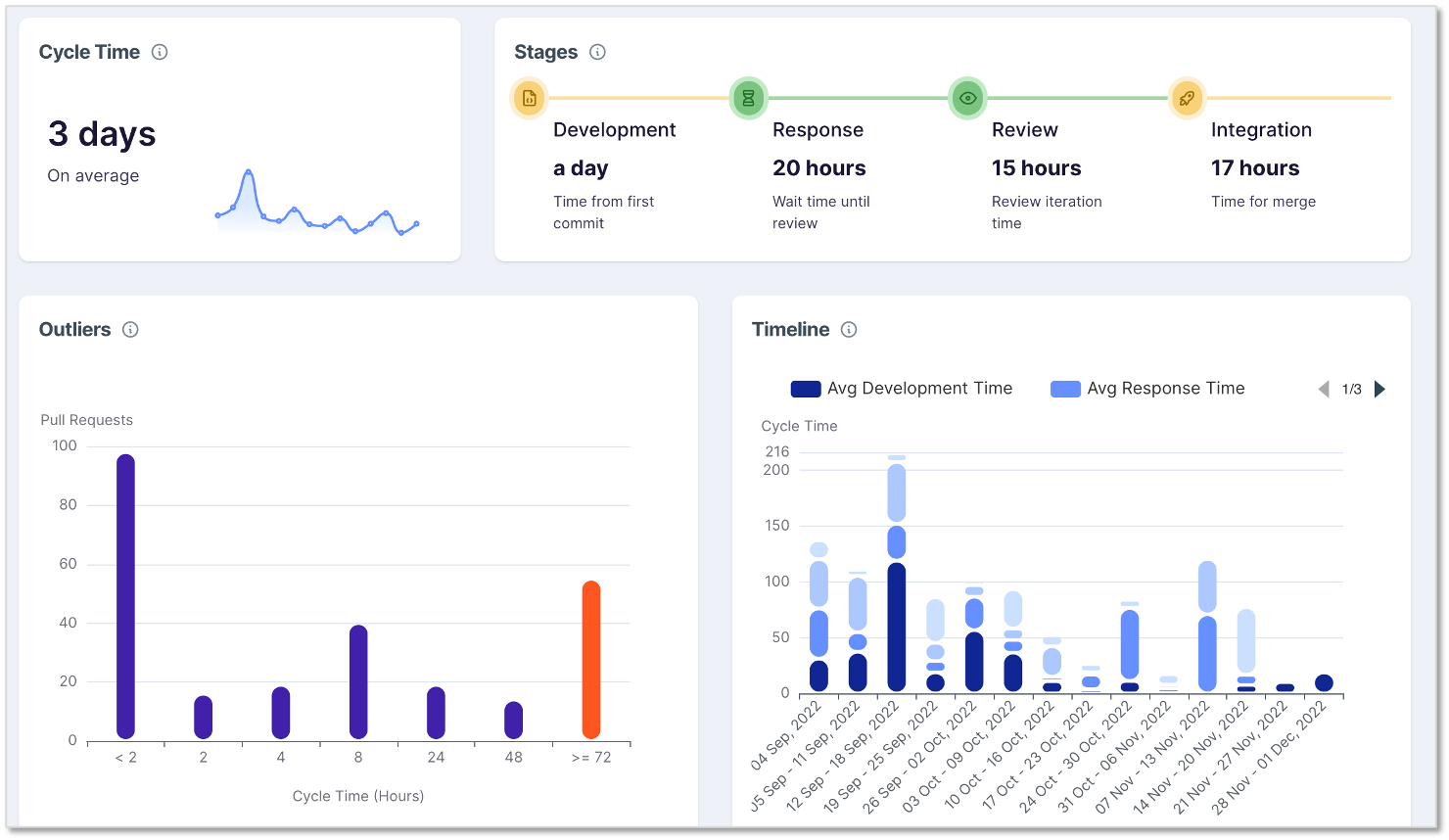
AI assisted development has arrived. It is a new reality that will rapidly permeate all parts of the software development lifecycle. As such, it is critical to build up the expertise and strategies to use that technology in the most beneficial way. Ensuring success requires the right level of visibility into the software engineering processes to provide the essential observability for decision makers. Those decisions are two-fold: Justifying the investment to executive teams with data-driven evidence, and being able to set the right guardrails for productivity improvements and process goals.
There is the inevitable hype cycle around AI assisted coding. To look beyond the hype it is important to measure the positive impact and steer its adoptions into the right direction, to ensure a positive business impact.
Software Engineering Intelligence platforms connect with your engineering data and give you the visibility into your processes and bottlenecks to get answers to the above questions. These platforms automate the measuring and analytics process for you to focus on the data-driven division making.
In future parts of this series we will dive into details of how predictive models can be applied to your engineering processes, how you can use AI to monitor your software engineering AI and how Software Engineering Intelligence platforms can help you to build high-performance engineering organisations.
You can register now for our free AI meets Engineering Productivity webinar.
Logilica is a leading software engineering intelligence platform. With insights across the software lifecycle including Git, Jira and CI/CD, Logilica makes it easy to empower data-driven software management. Logilica gives unrivalled visibility to your velocity, engineering bottlenecks and team health risks. Move from gut-feel to data transparency with our value stream analytics solution. Loved by engineering and platform teams who need to move fast and deliver predictably.
Ship faster with higher confidence by increasing engineering efficiency.